



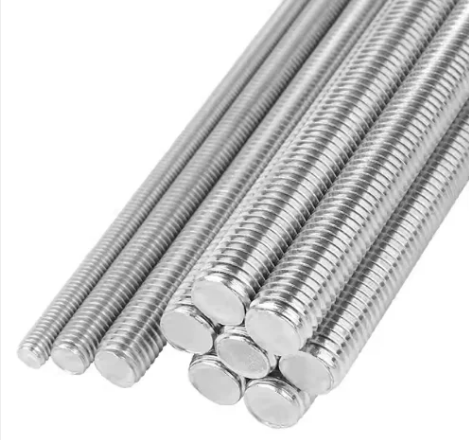
Full Thread Stud Bolts / Fully Threaded Rods
Full Thread Stud Bolts (also called Fully Threaded Studs, All-Thread Rods, Threaded Bars) are high-strength fastening components with continuous external threads along the entire length, widely used for connection, tension, anchoring and assembly in industrial construction, machinery, oil & gas, power engineering, steel structure and infrastructure projects.
Product Features
- Full-length continuous thread: Easy to install, adjustable position, strong versatility.
- High strength & stability: Uniform force distribution, good tensile and shear resistance.
- Wide compatibility: Matched with nuts, washers and anchors for different working conditions.
- Corrosion resistance available: Carbon steel, stainless steel, galvanized, hot-dip galvanized for long service life.
- Stable dimension: High precision thread, good interchangeability, reliable connection.
- Customizable: Length, diameter, material, grade and surface treatment can be customized.
Main Materials & Grades
- Carbon steel: 4.8, 8.8, 10.9, 12.9
- Stainless steel: A2 (304), A4 (316)
- Alloy steel, high-temperature steel, anti-corrosion special materials (custom)
Common Applications
- Steel structure connection and fixing
- Pipeline and equipment installation
- Bridge, tunnel and building anchoring
- Power plant, petrochemical and industrial engineering
- Mold, machinery and auto parts assembly
- Foundation, support and reinforcement projects
Post time: 2026-03-10 15:42:54
