
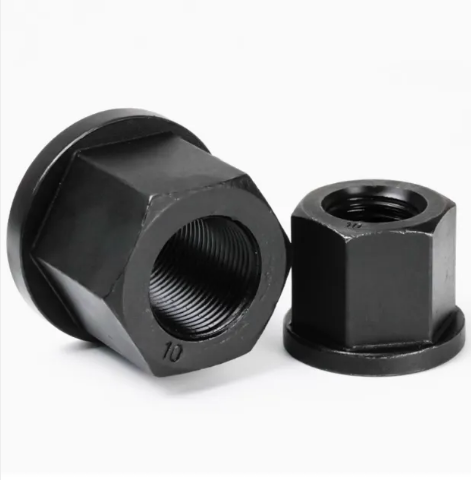
The Flange Nut (also known as a Hexagon Nut with Flange or DIN 6923) is a specialized hexagonal fastener featuring an integrated, wide bearing surface at its base. This built-in flange acts as a permanent washer, eliminating the need for separate washers during assembly. Designed for superior stability and load distribution, flange nuts are essential components in industries ranging from automotive manufacturing to heavy industrial machinery.
Unlike standard hex nuts, the flange nut’s wider contact area significantly reduces the risk of loosening under vibration and prevents damage to softer materials by distributing clamping force more evenly .
Key Features & Benefits
1. Integrated Washer Design
The most distinct feature of a flange nut is its integral flange. This design serves two critical functions:
Eliminates Separate Washers: Reduces parts count, simplifies inventory, and speeds up assembly time.
Even Load Distribution: The larger surface area disperses pressure across the joint, protecting delicate surfaces from indentation or deformation .
2. Superior Vibration Resistance
Many flange nuts incorporate serrations or teeth on the underside of the flange. These serrations bite into the mating surface when tightened, creating friction that resists rotational loosening caused by vibration and dynamic loads. This makes them ideal for high-vibration environments such as engines, railway systems, and industrial conveyors .
3. Enhanced Stability & Grip
The broad base provides a stable foundation, preventing the nut from tilting or cross-threading during installation. This ensures a secure, leak-proof connection in piping systems and structural assemblies .
4. Material Versatility
Flange nuts are available in various materials to suit specific environmental conditions:
Stainless Steel (304/316): Offers exceptional corrosion resistance, making it perfect for marine, outdoor, chemical, and food processing applications .
Carbon Steel (Grade 8/10.9): Provides high tensile strength for heavy-duty structural and automotive uses. Often zinc-plated or black oxide coated for added rust protection .
Alloy Steel: Used in extreme pressure and temperature scenarios .
Post time: 2026-05-21 10:38:35
