



H1: Rivet Nut – Reliable Blind Threaded Fastener for Thin Plate Assembly
In modern sheet metal fabrication, equipment manufacturing and automotive production, thin metal sheets, hollow profiles and closed box structures cannot install ordinary nuts from double sides. Rivet nut (also called rivnut) solves this pain point perfectly with one-sided blind installation. The vertical knurled barrel on our standard rivet nut tightly locks the hole wall during riveting, effectively preventing rotation and pull-out failure under vibration conditions. With cost-effective galvanized surface treatment, this rivet nut has become the most widely used internal thread embedded part in global industrial procurement.
H2: What Is a Rivet Nut & Its Working Principle
A rivet nut is a hollow threaded fastener installed by a pneumatic or hand rivet gun only from one side of the workpiece.
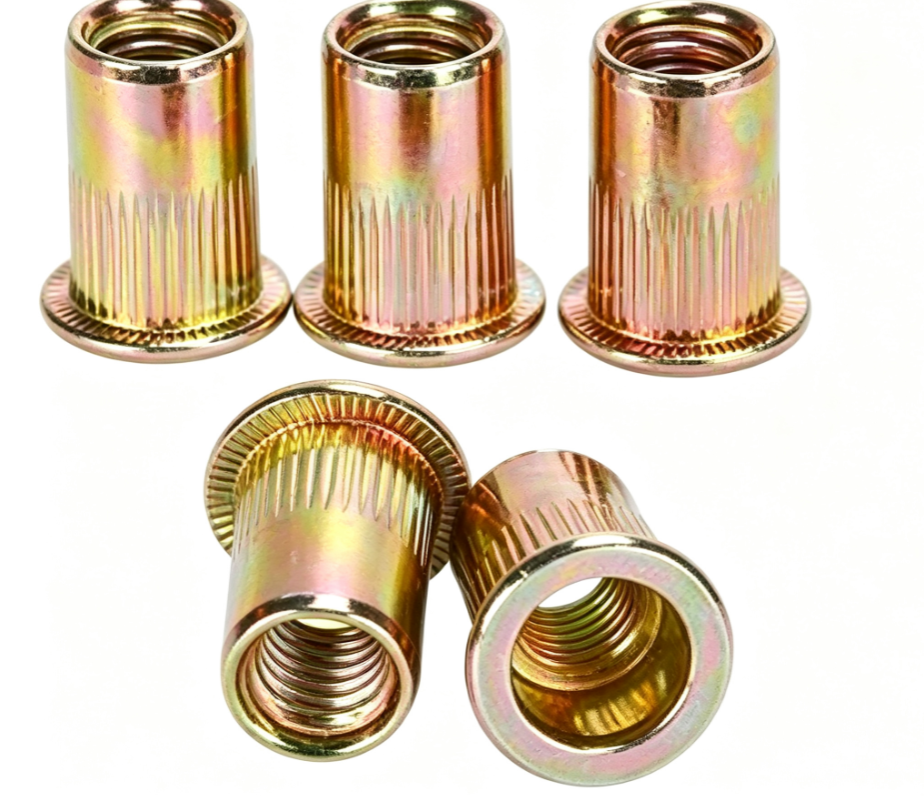
The product in the picture is a classic flat head knurled blind rivet nut, the most mainstream specification in the market.
2.Pull the rivet gun to squeeze the tail of the rivet nut to expand and form a locking flange on the back of the plate
3.The vertical knurls on the outer barrel are pressed into the metal hole wall to realize anti-rotation positioning
4.Complete fixed internal thread installation without welding, polishing or secondary processing
Compared with welded nuts, rivet nuts will not cause sheet deformation, paint peeling and thermal oxidation; compared with self-clinching nuts, rivnuts are applicable to thinner plates and easier for mass assembly.
H2: Product Feature Analysis of Our Galvanized Rivet Nut
H3: Vertical Knurled Barrel Structure
Uniform vertical knurls increase the occlusion force between the nut and the hole wall. It avoids idle rotation when tightening bolts, greatly improves torque retention and pull-out resistance, suitable for dynamic load and long-term vibration working environments.
H3: Standard Flange Flat Head Design
The circular flange fits closely to the surface of the workpiece, disperses pressure during riveting, and prevents thin plates from being squeezed and cracked. The surface is neat after installation without prominent protrusions.
H3: Color Zinc Plating Surface Treatment
The rivet nut in the picture adopts color galvanizing treatment. It has basic rust-proof performance, stable salt spray resistance, low cost and high cost performance, which is the preferred surface process for most indoor industrial equipment.
H3: Complete Standard Thread Sizes
Conventional metric specifications M3, M4, M5, M6, M8, M10, M12 are in stock, matching different sheet thickness grip ranges to meet the assembly demands of different industries.
H2: Core Advantages of Choosing Rivet Nuts for Production
✅ Single-sided blind installation: No need to operate on the back of the workpiece, greatly improving the assembly efficiency of closed boxes and tubular parts
✅ Reusable internal thread: Support repeated disassembly and maintenance of bolts, the thread is not easy to be damaged after multiple locking
✅ No high-temperature welding damage: Protect the original coating and appearance of the workpiece, reduce post-processing procedures
✅ Strong anti-loosening ability: Knurled structure cooperates with expansion flange to double fix, effectively solve the loosening problem of vibrating equipment
✅ Low use cost: Matching manual and pneumatic riveting tools, low tool investment cost for assembly lines
Post time: 2026-07-30 09:53:35
