



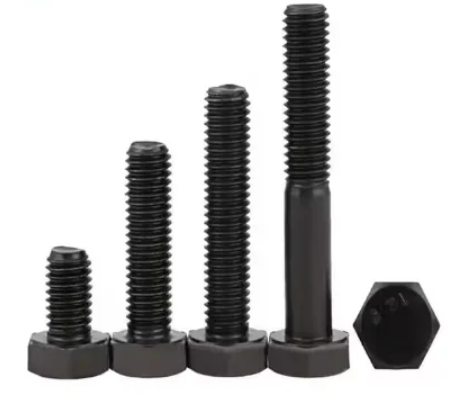
Hex bolts are primarily categorized based on their head structure:
- External Hex Bolt (Hex Bolt/Hex Head Bolt): This is the most common type, featuring a prominent external hexagonal head. It is versatile and used across numerous applications
- Internal Hex Screw (Hex Socket Screw): This type has a recessed hexagonal socket within its head, requiring a hex key (Allen key) for installation. It offers a clean appearance and is less prone to tool slippage
Material, Grades, and Standards
Hex bolts are manufactured from various materials to suit different requirements:
- Carbon Steel: The most common material, available in different strength grades (e.g., 4.8, 8.8, 10.9) 39. Higher grades like 8.8 and 10.9 indicate high-strength bolts 910.
- Stainless Steel (e.g., 304): Provides excellent corrosion resistance, ideal for outdoor, marine, or chemically exposed environments
- Alloy Steel: Used for specialized high-strength applications
Surface treatments like zinc plating or galvanization are often applied to enhance corrosion resistance
Production and quality are governed by international and national standards, such as the ISO series (e.g., ISO 4014, ISO 4017) and Chinese GB/T standards (e.g., GB/T 5782, GB/T 5783)
Post time: 2026-03-13 13:39:11
