



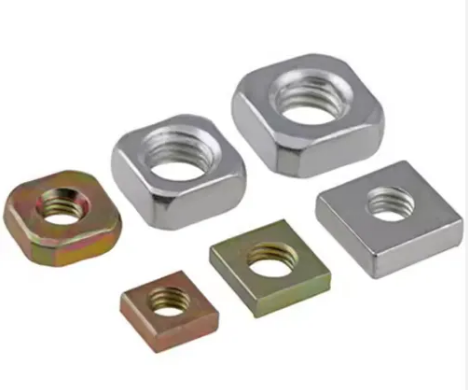
Square Nuts: Superior Fastening Solutions for Demanding Applications
Square nuts are specialized fasteners distinguished by their four-sided geometry. This design offers significant advantages over conventional hexagonal nuts, including enhanced torque resistance, a larger bearing surface, and reduced susceptibility to rounding during installation or removal. They are engineered for structural, industrial, and mechanical applications where joint integrity, durability, and reliability are critical.
Key Product Types and Features
Slotted Square Nuts
These nuts feature precision-cut slots along their edges, enabling the insertion of a cotter pin or safety wire through the bolt to positively lock the assembly. This mechanism is ideal for preventing accidental loosening under vibration, making them suitable for automotive suspension systems, aircraft components, and other safety-critical joints. Heavy-Duty Square Nuts
Manufactured from high-tensile steel with increased wall thickness and tight tolerances, these nuts are designed to handle extreme loads and harsh environmental conditions. They are commonly used in construction frameworks, bridge assemblies, and heavy industrial machinery where exceptional load-bearing capacity is required. Square Lock Nuts
Incorporating built-in locking mechanisms such as nylon inserts or deformed threads, these nuts create friction or mechanical interference to resist vibration-induced loosening without additional hardware. They are effective in applications like automotive engines, industrial motors, and equipment subject to constant vibration. Distorted Thread Square Nuts
Featuring a deliberately deformed thread profile, these nuts create an interference fit when threaded onto a bolt, generating radial pressure to prevent rotation. They offer high resistance to vibration and shock loads and are often used in mission-critical aerospace, defense, and precision machinery applications.
Material Selection for Durability and Performance
The performance and longevity of square nuts are fundamentally determined by material choice and manufacturing processes.
- Carbon Steel: The most widely used material due to its excellent tensile strength, affordability, and versatility. Grades such as ASTM A307 or SAE Grade 5 are common for general-purpose applications in construction and machinery. Protective coatings like zinc plating are often applied to enhance corrosion resistance.
- Stainless Steel: Provides mechanical strength comparable to carbon steel while offering superior resistance to rust and corrosion, thanks to its chromium content. Grades AISI 304 and AISI 316 are preferred for applications involving moisture exposure, chemical environments, food processing, or architectural installations.
- Alloy Steel: Engineered for extreme conditions, these nuts are alloyed with elements like chromium, nickel, and molybdenum to enhance toughness, hardness, and tensile strength at elevated temperatures. Specifications such as ASTM A194 Grade 4 are used in pressure vessels, oil and gas pipelines, and power generation equipment.
- Heat-Treated Nuts: A critical process involving quenching and tempering that refines the steel's microstructure to significantly increase hardness, strength, and resistance to wear and fatigue. Heat-treated nuts meeting standards like Property Class 10.9 or 12.9 are essential for critical load-bearing applications in vehicle suspensions, heavy machinery, and structural engineering.
Application Advantages
Square nuts are the preferred choice in scenarios where standard fasteners may fail. Their larger surface area distributes clamping force more effectively, reducing stress on the connected material. The square shape provides superior grip for wrench engagement, minimizing the risk of tool slippage and fastener rounding. These attributes make them indispensable for ensuring long-term joint integrity in high-stress, high-vibration, or safety-critical environments.
Post time: 2026-04-02 16:25:19
