



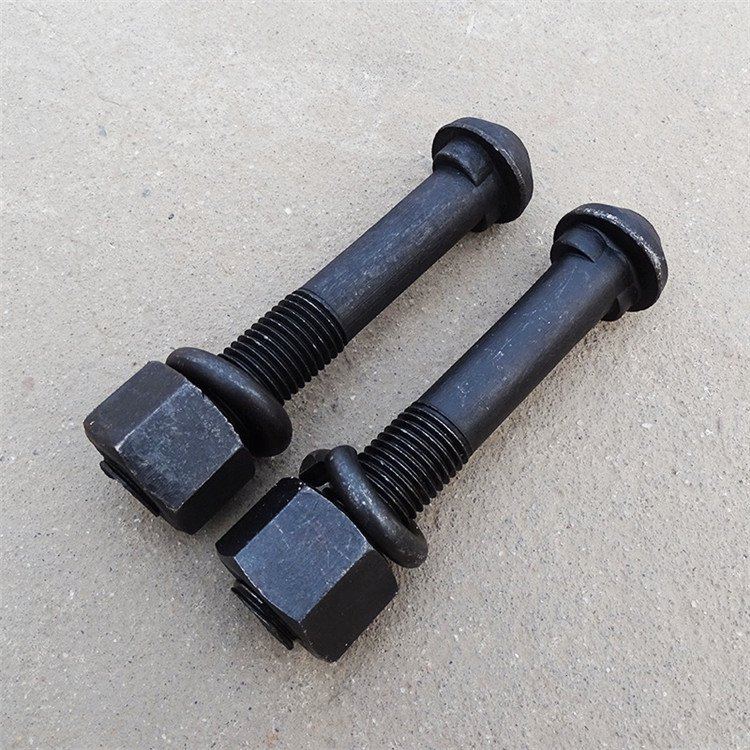
The rail joint bolts, also known as fish-tail bolts, are the fastening components for the rail joint plates. They are classified into ordinary joint bolts and high-strength joint bolts based on their material. They are the core connecting elements of the railway seamless track. The heads of the ordinary bolts adopt a semi-spherical top surface with a square shape, while the semi-spherical top surface of the 8.8-grade high-strength bolts is enhanced with two additional convex ribs at the square head area. The 10.9-grade high-strength bolts have a flat conical top surface. The bolt length is 150-170mm, and the elliptical protruding neck at the square head area can prevent the phenomenon of slippage when tightening the nut.
The rail joint is one of the three weakest links in the track structure. The maintenance and repair work of the joint accounts for 60% of the track maintenance workload. The most fundamental cause of the joint's defects lies in the discontinuity of the track structure and the unevenness of the rail surface, which leads to additional dynamic effects. The joint defects manifest as bolt loosening, rail gap expansion, and deterioration of the geometric shape of the rail surface. Measures such as replacing ballast, eliminating empty suspension plates, and correcting the rate of track gauge change are needed for comprehensive. Daily maintenance follows the principle of 'prevention first, prevention and treatment combined, and equal emphasis on maintenance and repair', and is guaranteed by the 'window repair' system to ensure operational safety.
Post time: 2026-03-13 17:33:49
