



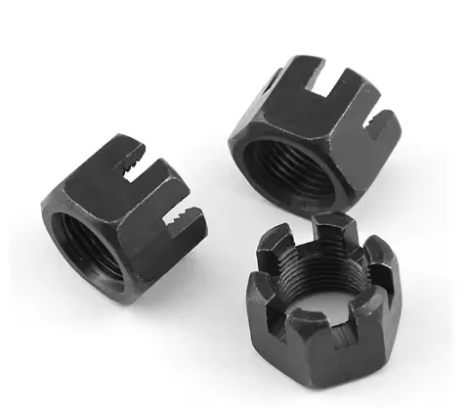
Hexagon slotted nuts, also known as slotted hex nuts or castle nuts, are specialized mechanical locking fasteners designed for applications requiring high reliability against vibration and shock. Their unique design integrates a hexagon body with machined slots on the top, allowing for secure locking with a cotter pin (split pin) when used with a correspondingly drilled bolt or stud. This guide provides essential information for engineers, procurement specialists, and designers seeking robust fastening solutions.
Product Definition and Standards
The term "Hexagon Slotted Nut" is the standard English designation. Internationally recognized classifications include "Style 1" and "Style 2" designs, differentiated by dimensional specifications and performance grades (e.g., A, B, C). These standards ensure interoperability and quality. Common international and national standards include ISO references and the Chinese GB/T series, such as GB/T 6178-1986 for "Hexagon slotted and castle nuts, style 1--Product grades A and B" 1 and GB/T 6180-1986 for "Hexagon slotted and castle nuts, style 2--Product grades A and B" 24. Specialized variants exist for demanding sectors like aerospace, exemplified by standards such as GB/T 44320-2024 for "Hexagonal slotted reduced height nuts with MJ threads for aerospace"
Key Features and Locking Mechanism
The primary function is mechanical vibration resistance. The locking process involves three steps: 1) tightening the nut to the specified torque; 2) aligning one of the nut's slots with the cross-hole in the bolt shaft; 3) inserting a cotter pin through the aligned slot and bolt hole, then bending (splaying) the pin's ends to prevent disengagement 9. This creates a positive mechanical lock that directly prevents rotational loosening, making it superior to many friction-based locking methods in high-vibration environments such as automotive wheel axles, heavy machinery, and structural assemblies
Material Grades and Specifications
Hexagon slotted nuts are manufactured in various material grades and strength classes to suit different application requirements.
- Carbon Steel: Common grades include Grade 8 and other high-strength classifications, often with surface treatments like black oxide (发黑) or galvanization for corrosion resistance
- Stainless Steel: Grades such as A2-70 (304 stainless) offer excellent corrosion resistance for harsh environments
- Performance Grades: Standards define product grades (A, B, C). Grades A and B typically denote higher precision and strength, while Grade C may be used in applications with lower surface finish requirements
- Size Range: Commonly available metric sizes range from M6 to M24, catering to a wide spectrum of load-bearing needs
Typical Applications
These nuts are indispensable in scenarios where failure due to loosening is not an option:
- Automotive and Transportation: Critical for securing wheel bearings, axle assemblies, and suspension components.
- Heavy Equipment and Machinery: Used in construction, agricultural, and mining equipment subject to constant impact and vibration.
- Aerospace and Aviation: Specialized thin or reduced-height versions with MJ threads are employed in aircraft assemblies due to their high strength-to-weight ratio and guaranteed reliability
- General Industrial Assembly: Any machinery or structure exposed to operational vibrations or dynamic loads.
Post time: 2026-03-25 14:10:51
