



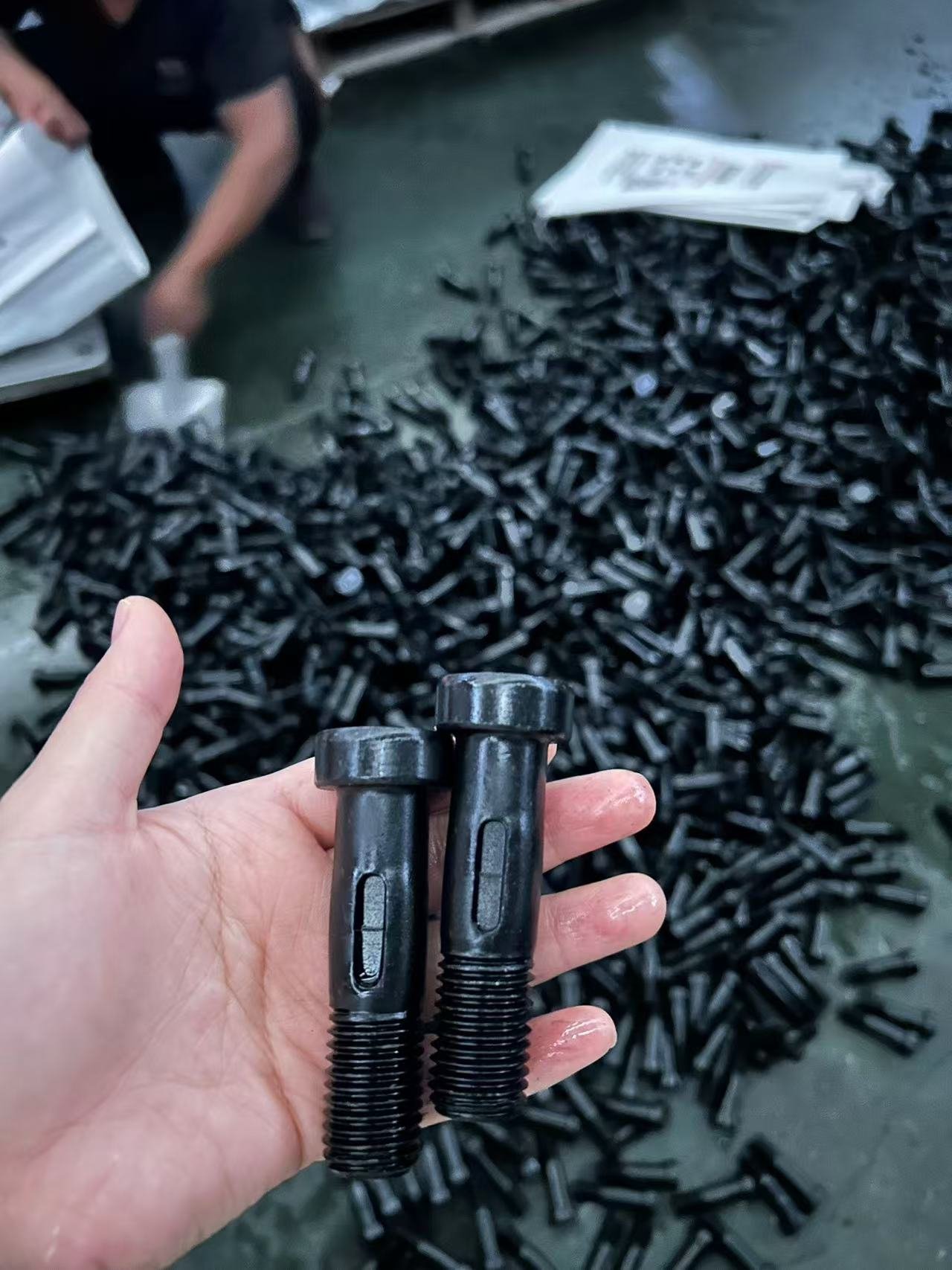
What are the differences between high-strength bolts and ordinary bolts? We can distinguish them by comparing the differences in raw materials used, strength grades, force characteristics, and application scope.
1) Different raw materials: The bolts, nuts and washers of high-strength bolts are all made of high-strength steel, such as 45 steel, 40 boron steel, etc.; while ordinary bolts are usually made of Q235 steel.
After being manufactured, high-strength bolts need to undergo heat treatment to enhance their strength and hardness; ordinary bolts generally do not require heat treatment.
(2) High-strength bolts commonly use grades 8.8s, 10.9s, and 12.9s, among which grade 10.9 is the most frequently used; ordinary bolts have lower strength levels, typically being grades 4.4, 4.8, 5.6, and 8.8.
The numerical value of the strength grade, taking the 8.8S grade as an example, the first number 8 indicates that the nominal tensile strength of the bolt material is 8 * 100 = 800 MPa, and the second number 8 indicates that the ratio of the yield strength to the tensile strength of the bolt material is 0.8, that is, the yield strength is 640 MPa. The letter S indicates the standard type. The strength grade of ordinary bolts, such as 4.8 grade, refers to the tensile strength being 4 * 100 = 400 MPa, and the number 0.8 still represents the ratio of the yield strength to the tensile strength of the bolt material being 0.8, that is, the yield strength is 320 MPa.
(3) Different force transmission methods: High-strength bolts apply pre-tension force and rely on the friction between the contact surfaces of the connected components to transmit external forces; ordinary bolt connections rely on the shear resistance of the bolt rod and the pressure-bearing capacity of the hole wall to transmit shear forces. The pre-pressure generated when tightening the nut is very small and can be ignored.
(4) Ordinary bolts can be reused; high-strength bolts are generally used for permanent connections and cannot be reused.
High-strength bolts are prestressed bolts. For friction type, the specified prestress is applied using a torque wrench; for compression type, the bow-shaped head needs to be removed; for ordinary bolts, they can be simply tightened with a regular wrench.
Post time: 2026-01-23 14:56:06
